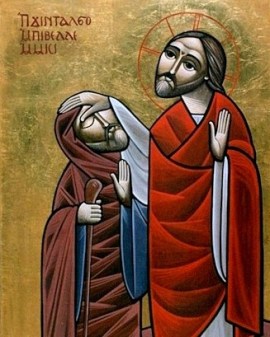
Now as Jesus passed by, He saw a man who was blind from birth. And His disciples asked Him, saying, “Rabbi, who sinned, this man or his parents, that he was born blind?”
Jesus answered, “Neither this man nor his parents sinned, but that the works of God should be revealed in him. I must work the works of Him who sent Me while it is day; the night is coming when no one can work. As long as I am in the world, I am the light of the world.”
When He had said these things, He spat on the ground and made clay with the saliva; and He anointed the eyes of the blind man with the clay. And He said to him, “Go, wash in the pool of Siloam” which is translated, Sent. So he went and washed, and came back seeing.
Therefore the neighbors and those who previously had seen that he was blind said, “Is not this he who sat and begged?”
Some said, “This is he.” Others said, “He is like him.”
He said, “I am he.”
Therefore they said to him, “How were your eyes opened?”
He answered and said, “A Man called Jesus made clay and anointed my eyes and said to me, “Go to the pool of Siloam and wash.’ So I went and washed, and I received sight.”
Then they said to him, “Where is He?”
He said, “I do not know.”
They brought him who formerly was blind to the Pharisees. Now it was a Sabbath when Jesus made the clay and opened his eyes. Then the Pharisees also asked him again how he had received his sight. He said to them, “He put clay on my eyes, and I washed, and I see.”
Therefore some of the Pharisees said, “This Man is not from God, because He does not keep the Sabbath.”
Others said, “How can a man who is a sinner do such signs?” And there was a division among them.
They said to the blind man again, “What do you say about Him because He opened your eyes?”
He said, “He is a prophet.”
But the Jews did not believe concerning him, that he had been blind and received his sight, until they called the parents of him who had received his sight. And they asked them, saying, “Is this your son, who you say was born blind? How then does he now see?”
His parents answered them and said, “We know that this is our son, and that he was born blind; but by what means he now sees we do not know, or who opened his eyes we do not know. He is of age; ask him. He will speak for himself.” His parents said these things because they feared the Jews, for the Jews had agreed already that if anyone confessed that He was Christ, he would be put out of the synagogue. Therefore his parents said, “He is of age; ask him.”
So they again called the man who was blind, and said to him, “Give God the glory! We know that this Man is a sinner.”
He answered and said, “Whether He is a sinner or not I do not know. One thing I know: that though I was blind, now I see.”
Then they said to him again, “What did He do to you? How did He open your eyes?”
He answered them, “I told you already, and you did not listen. Why do you want to hear it again? Do you also want to become His disciples?”
Then they reviled him and said, “You are His disciple, but we are Moses’ disciples. We know that God spoke to Moses; as for this fellow, we do not know where He is from.”
The man answered and said to them, “Why, this is a marvelous thing, that you do not know where He is from; yet He has opened my eyes! Now we know that God does not hear sinners; but if anyone is a worshiper of God and does His will, He hears him. Since the world began it has been unheard of that anyone opened the eyes of one who was born blind. If this Man were not from God, He could do nothing.”
They answered and said to him, “You were completely born in sins, and are you teaching us?” And they cast him out.
Jesus heard that they had cast him out; and when He had found him, He said to him, “Do you believe in the Son of God?”
He answered and said, “Who is He, Lord, that I may believe in Him?”
And Jesus said to him, “You have both seen Him and it is He who is talking with you.”
Then he said, “Lord, I believe!” And he worshiped Him.
And Jesus said, “For judgment I have come into this world, that those who do not see may see, and that those who see may be made blind.”
Then some of the Pharisees who were with Him heard these words, and said to Him, “Are we blind also?”
Jesus said to them, “If you were blind, you would have no sin; but now you say, “We see.’ Therefore your sin remains.
(John 9:1-41).
Contemplation 1 – Our time on this earth is short
While therefore it is day, says He, let us work the works of Him that sent us; for the night will come, when no man can work. In these words He calls the time of bodily life, day; and the time we are in death, He calls night. For since the day was given for works, but the night for rest and sleep, therefore the time of life in which we ought to work what is good, people call day; and the time of sleeping, in which nothing whatever can be done, they call night. (John 9:4)
While therefore it is day, says He, let us work the works of Him that sent us; for the night will come, when no man can work. In these words He calls the time of bodily life, day; and the time we are in death, He calls night. For since the day was given for works, but the night for rest and sleep, therefore the time of life in which we ought to work what is good, people call day; and the time of sleeping, in which nothing whatever can be done, they call night. [St. Cyril of Alexandria, Commentary on the Gospel of St. John, Book VI]
+ Lord help me to remember at all times that this earth is temporary, that the ultimate goal of my life in Your Kingdom in heaven. Help me therefore to do Your works, to put aside the love of sin and this world, for without You I can do nothing.
Contemplation 2 – Obedience provides healing
When He had said these things, He spat on the ground and made clay with the saliva; and He anointed the eyes of the blind man with the clay. And He said to him, “Go, wash in the pool of Siloam” which is translated, Sent. So he went and washed, and came back seeing. (John 9:6-7)
The blind man accordingly departs with what haste he can, and washes, and without delay performs all that was bidden him, showing as it were in his own person the ready obedience of the Gentiles, concerning whom it is written: He inclined His ear to the preparation of their hearts (Ps 10:17). The wretched Jews then were hard of heart, but they of the Gentiles were altogether docile in obedience and bear witness of it in experience. The man having at once, removed his blindness, washing it away together with the clay, now returns, seeing. For it was Christ’s pleasure that thus it should come to pass. Excellent therefore is faith, which makes God-given grace to be strong in us; and harmful is hesitation. For the double-minded man is unstable in all his ways, as it is written, and shall receive nothing whatever from the Lord. [St. Cyril of Alexandria, Commentary on the Gospel of St. John, Book VI]
+ Lord grant that I be quick to listen and obey, that your grace of your Holy Spirit may work within me. Remove from me my blindness and create in me new eyes, simple eyes that do not see evil in others but only Your goodness, and Your goodness manifested in those around me.
Contemplation 3 – Persisting in sin of our own accord yields a harsher punishment
Jesus said to them, “If you were blind, you would have no sin; but now you say, “We see.’ Therefore your sin remains. (John 9:41)
The Saviour once more confounds them, tempering His reproof with skill. For He holds aloof from all reviling and puts them out of countenance by setting before them the force of the truth: He shows them that they derive no advantage from possessing sight, or rather that they fell into a worse condition than one who could not see at all. For the blind man, saith He, by not beholding any of the deeds miraculously wrought, escaped without sin, and is so far blameless; but they who have been watchers and beholders of the marvellous deed, and through great folly and evilness of disposition have not accepted the faith in consequence of them, make their sin difficult of removal, and it is really hard to escape from the condemnation which such conduct incurs. Therefore it is not hard to understand the meaning of this as regards bodily blindness and restoration to sight: and when we pass to that which is to be understood by analogy, receiving our impressions from the argument itself, we shall again repeat the same signification: that the man who does not understand may claim his pardon with excellent reason from the judge, but he who is keen of intellect and understands his duty, and then, having indulged his debasing inclination in the baser principles of his mind, and given himself to the sway of pleasures and not of duty, shall shamelessly claim compassion,—-the request for which he ought to be punished shall in no wise be granted, and he will very justly perish for having kept in himself a sin without excuse. For instance Our Lord Jesus Christ signifies exactly the same thing in the Gospels, saying: He that knew his lord’s will, and did it not, shall be beaten with many stripes (Lk 12:47). For the charge against him that knew not is merely that of ignorance; but against him that understood and yet inconsiderately refused to act, the charge is that of overweening presumption. Observe again how guardedly accurate was the language of the Saviour on this occasion also; for He does not say plainly, “You see,” but He says: You say, We see. For it would of course have been very much beside the mark, to ascribe understanding to those who possessed a mind so blind and emptied of light as to dare to say concerning Him: We know that this Man is a sinner. Self-condemned therefore are the Jews, who affirm of themselves that they see, but do not act at all as they ought; aye, most emphatically self-condemned, for they know the will of the Lord, but are so self-conceited that they thus resist even His mightiest miracles. [St. Cyril of Alexandria, Commentary on the Gospel of St. John, Book VI]
+ Lord grant me true repentance, change my heart of stone into a heart of flesh. Help me to change my life to do according to your words, and not merely to listen.

 FellowsoftheEleventhHour